
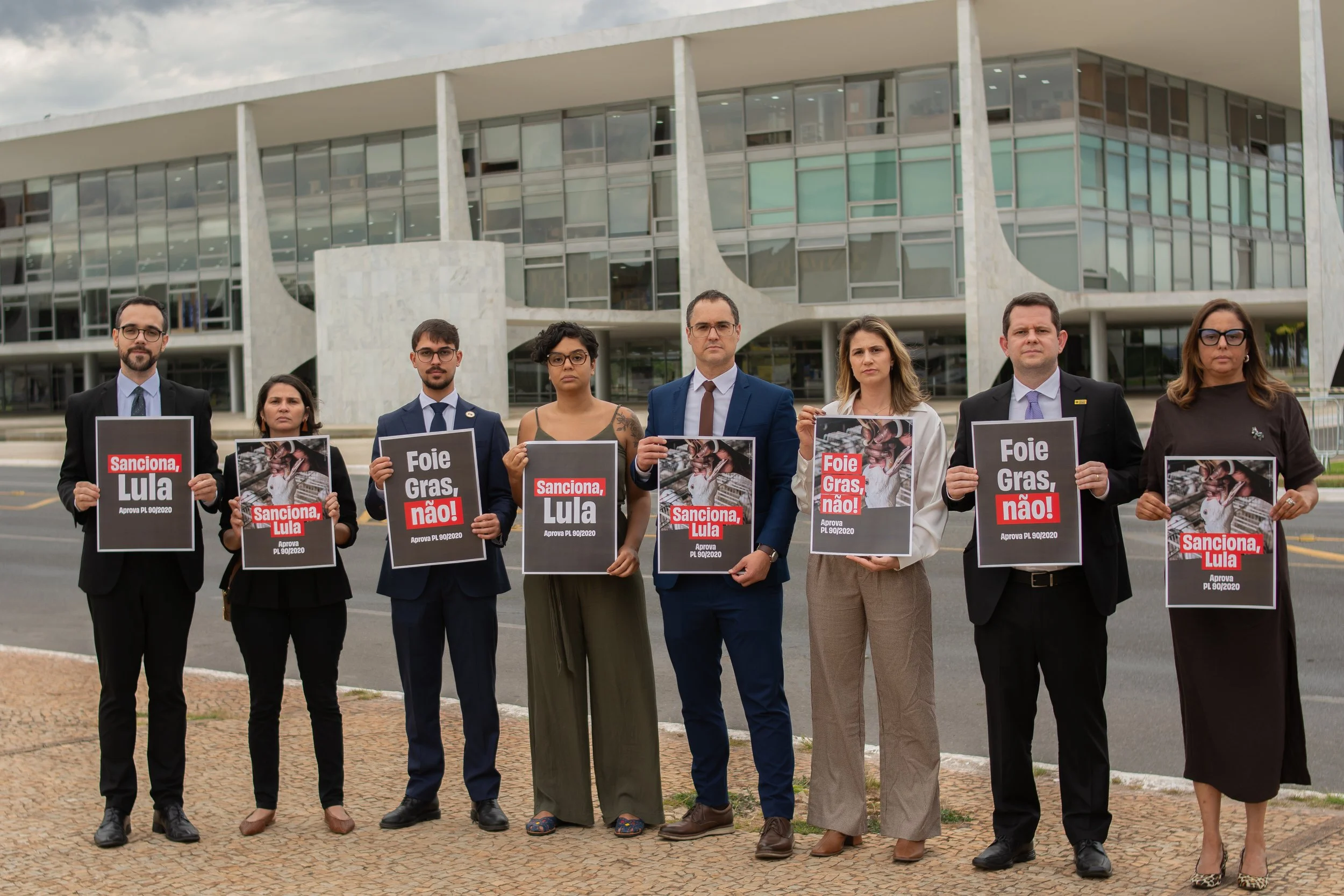
July 24, 2026—Brazil has reached a historic milestone for animal protection. On July 23, 2026, Bill No. 90/2020 was officially enacted as Law No. 15,475/2026, making Brazil the first country in the world to legally prohibit both the production and sale of foie gras—a product obtained through the force-feeding of ducks and geese.
This landmark achievement represents an unprecedented advance for animal welfare and is the result of years of political advocacy led by civil society organizations. The bill was one of the legislative priorities included in Sinergia Animal's Animal Agenda 2026, reaffirming the organization's commitment to strengthening legal protections for animals.
An Achievement Built Through Coalition
This historic victory was made possible through the combined efforts of organizations, experts, parliamentarians, and supporters united in ending one of the cruelest practices in the food industry.
Among the organizations and parliamentary groups involved throughout the campaign were Sinergia Animal, Mercy For Animals (MFA), the National Association of Animal Rights Lawyers (ANAA), the National Confederation of Animal Rights Defense Entities (CONEDAN), the National Forum for Animal Protection and Defense, the Mixed Environmental Parliamentary Front of the National Congress, and the Parliamentary Front in Defense of Animals, among others.
A Journey Marked by Challenges
Passing the law required overcoming major political and legislative obstacles.
The first major challenge arose during deliberations in the Constitution and Justice Committee (CCJ). After a member of the rural caucus presented an initial opinion recommending the bill's rejection, the coalition secured the appointment of a new rapporteur and launched a broad public mobilization campaign. Over six weeks, approximately 865,000 messages were sent to committee members, accompanied by an intensive social media campaign targeting the lawmakers responsible for the vote. Together, these efforts helped reverse the outcome.
The second decisive moment came when opponents attempted to fast-track the bill directly to the plenary through a formal procedural request. To stop the move, supporters sent nearly 250,000 emails to Brazil's 513 federal deputies, while allied lawmakers worked directly with their colleagues to block the proposal.
The third and final major challenge emerged during the presidential approval stage. Representatives of the French foie gras industry lobbied the Brazilian government to veto the ban on the sale of the product. In response, coalition organizations published an open letter to the President of the Republic, generating widespread media coverage, mobilizing lawmakers in support of the bill, and launching a large-scale digital campaign that even received public backing from the First Lady.
What Led to This Victory
The campaign's success was driven by a combination of complementary strategies.
Strong legal and technical arguments provided the foundation for the bill, but it was public mobilization that ultimately propelled its approval. At the same time, as international pressure mounted against the proposal, the coalition successfully reframed the debate, presenting the measure not only as an animal protection issue but also as a matter of national sovereignty and Brazil's right to establish its own animal welfare standards. This approach significantly increased the political cost of a potential presidential veto.
Another key factor was the coalition's ability to build cross-party support. Collaboration with lawmakers from across the political spectrum—including representatives from centrist and conservative parties—proved essential to advancing the bill through stages traditionally influenced by agribusiness interests.
Finally, the campaign maintained consistent pressure over several years while strategically seizing the political opportunity to ensure the bill reached the presidential approval stage before the October elections.
A Historic Precedent for Animal Protection
The enactment of Law No. 15,475/2026 sets an important international precedent by demonstrating that legislation can successfully eliminate products derived from practices of extreme cruelty toward animals.
For Sinergia Animal, this achievement reinforces the importance of evidence-based political advocacy, coalition building, and sustained engagement with decision-makers. More than a legislative victory, it marks a significant step toward a more ethical and compassionate food system for millions of animals.