
Beyond the climate trade-off: why animal welfare and planetary health should not be treated as competing goals
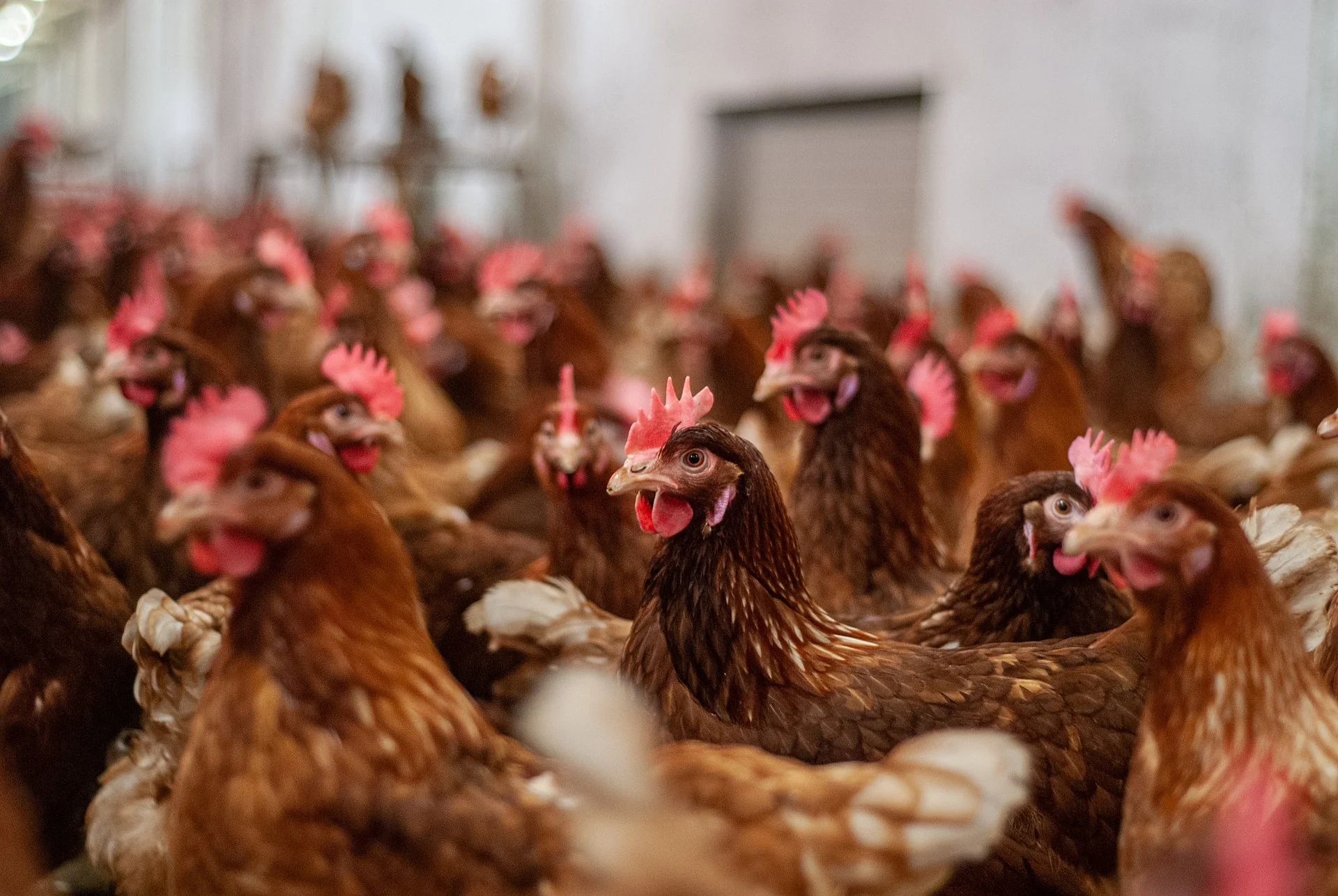
Stefano Belacchi / Essere Animali / We Animals
By Fernanda Vieira, Animal Welfare & Research Director at Sinergia Animal.
The recent Guardian article reporting that organic eggs can have a higher climate impact than eggs produced by caged hens raises an important question about how we evaluate the sustainability of food production. The underlying research deserves attention: according to the study, replacing UK egg production entirely with organic free-range production could result in substantially higher greenhouse-gas emissions, largely because more hens and more land would be required to produce the same quantity of eggs. The researchers also found higher impacts for land use, eutrophication and acidification.
But the article risks leaving readers with a misleading choice: better animal welfare or a healthier planet.
That is not the choice we should be making.
The evidence instead points towards a much more fundamental conclusion: we need to transform the food system itself, rather than optimize one dimension of an unsustainable system at the expense of another.
Sustainability cannot be reduced to greenhouse-gas emissions
Greenhouse-gas emissions are an essential measure of food-system sustainability, but they are not the only one.
Food production affects land, freshwater, biodiversity, soil, pollution, animal health, human health and livelihoods. The Food and Agriculture Organization of the United Nations recognizes that industrial animal production is associated with climate change, land degradation and biodiversity loss, while also affecting livelihoods, nutrition and food security.
The 2025 EAT-Lancet Commission goes further. Its assessment considers food systems against all nine planetary boundaries, and concludes that food systems are the largest contributor to the transgression of five of them. It also places justice at the center of food-system transformation, including access to nutritious food, decent work and the rights of people affected by food production.
The IPCC has similarly concluded that shifting towards healthier, more plant-rich diets and reducing consumption of animal-source foods can reduce pressure on forests and land used for feed, support biodiversity and improve planetary health, while also producing important health benefits.
This changes the question.
The objective cannot simply be to identify the most resource-efficient way of producing today's quantity of eggs, meat or dairy. We also need to ask whether producing and consuming today's quantity of animal products is compatible with a liveable planet in the first place.
One Health asks us to stop separating these problems
This is where the One Health and One Welfare approaches are particularly important.
One Health recognizes that human, animal, plant and ecosystem health are interconnected. The WHO, FAO, UNEP and WOAH have all adopted this system's perspective, precisely because threats such as zoonotic disease, antimicrobial resistance, food safety and environmental degradation cannot be addressed effectively in isolation.
One Welfare complements this approach by explicitly bringing animal welfare, human wellbeing and the environment into the same analytical framework. It recognizes that these dimensions are interconnected and that sustainable progress should not be achieved by improving one while causing significant harm to another.
This is particularly relevant to animal agriculture.
A production system should not be considered sustainable simply because it produces food with fewer greenhouse-gas emissions if doing so depends upon systematically compromising the biological and behavioural needs of sentient animals.
The answer is not to choose between these objectives. The answer is to design food systems capable of meeting them simultaneously.
And the evidence on cages is not ambiguous
There is an important distinction that the climate comparison can obscure.
The study discussed by The Guardian evaluates organic free-range production versus caged production. Its findings therefore cannot be generalized to every cage-free system, nor do they demonstrate that cages are preferable from an overall animal-welfare perspective. Indeed, the authors themselves acknowledge that the research does not include several environmental dimensions, including biodiversity and pesticide use.
More importantly, the scientific evidence concerning laying-hen welfare is clear that cages impose important welfare constraints.
The European Food Safety Authority's 2023 assessment identified inability to perform comfort behaviours, inability to perform exploratory and foraging behaviours, and restriction of movement as highly relevant welfare consequences associated with cage systems. EFSA recommends non-cage systems, with appropriate substrate and environmental enrichment, to allow hens to perform these behaviours.
One impossible thing to ignore: antimicrobial resistance
The misuse of antibiotics in factory farming is fueling the rise of antimicrobial resistance (AMR), a global health crisis that makes infections harder or impossible to treat. In 2019 alone, AMR was associated with nearly 5 million deaths worldwide
Factory Farms Misuse AntibioticsMore than 70% of antibiotics sold worldwide are used for animals raised on farms. In overcrowded, unsanitary conditions, animals are often administered antibiotics, not just to treat disease, but also to prevent it or promote growth, in countries where this misuse is still allowed. This misuse enables bacteria to evolve and become resistant to treatment, rendering common human infections more deadly. The World Health Organization ranks AMR as one of the top global public health and development threats.
Stressed Animals Are More Vulnerable to DiseaseAnimals in factory farms endure high stress due to confinement, overbreeding, and poor welfare. This chronic stress weakens their immune systems, increasing the risk of disease and the spread of harmful bacteria, such as E. coli, Salmonella, and Campylobacter—all of which can be transmitted to humans.
Caged Systems May Amplify Public Health RisksAnimals kept in intense confinement systems, such as cages, pose a significant threat to public health, mainly because they are chronically stressed and immunosuppressed. These unnatural environments expose animals to persistent physical and psychological stressors, including overcrowding, limited space to move, and a lack of opportunities for normal social interaction. Chronic stress activates the hypothalamic-pituitary-adrenal (HPA) axis, increasing stress hormones that suppress the immune system and render animals more susceptible to infections. In short, chronic stress and poor welfare conditions experienced by animals in industrial farms compromise their immune defenses, making industrial farming not only an ethical concern but also a significant public health risk.
A more useful question
What food system can provide nutritious food to people while remaining within planetary boundaries, protecting biodiversity and ecosystems, safeguarding human and animal health, supporting workers and producers, and respecting the biological and behavioural needs of the animals involved?
One Health and One Welfare give us a framework for rejecting this false binary.
The future of food production should respect nature, animals, workers, farmers and consumers simultaneously. That will require a combination of measures: reducing excessive consumption of animal products; increasing the availability and affordability of nutritious plant-rich foods; improving farming practices; protecting and restoring biodiversity; reducing pollution and antimicrobial resistance; supporting farmers and workers through the transition; and ensuring that animals who remain within food systems are kept in conditions that meet their biological and behavioural needs.
The challenge, therefore, is not to find the most efficient way to perpetuate the food system we have.
It is to build a different food system — one that can provide healthy food for people without exceeding the ecological limits of the planet or treating the welfare of sentient beings as an acceptable cost of efficiency.