
New footage from an industrial farm in Malaysia reveals the extreme suffering of hens confined in cages. Following the rollback of global commitments by the giant behind Hellmann’s, we took our mobilization straight to the company’s UK headquarters.
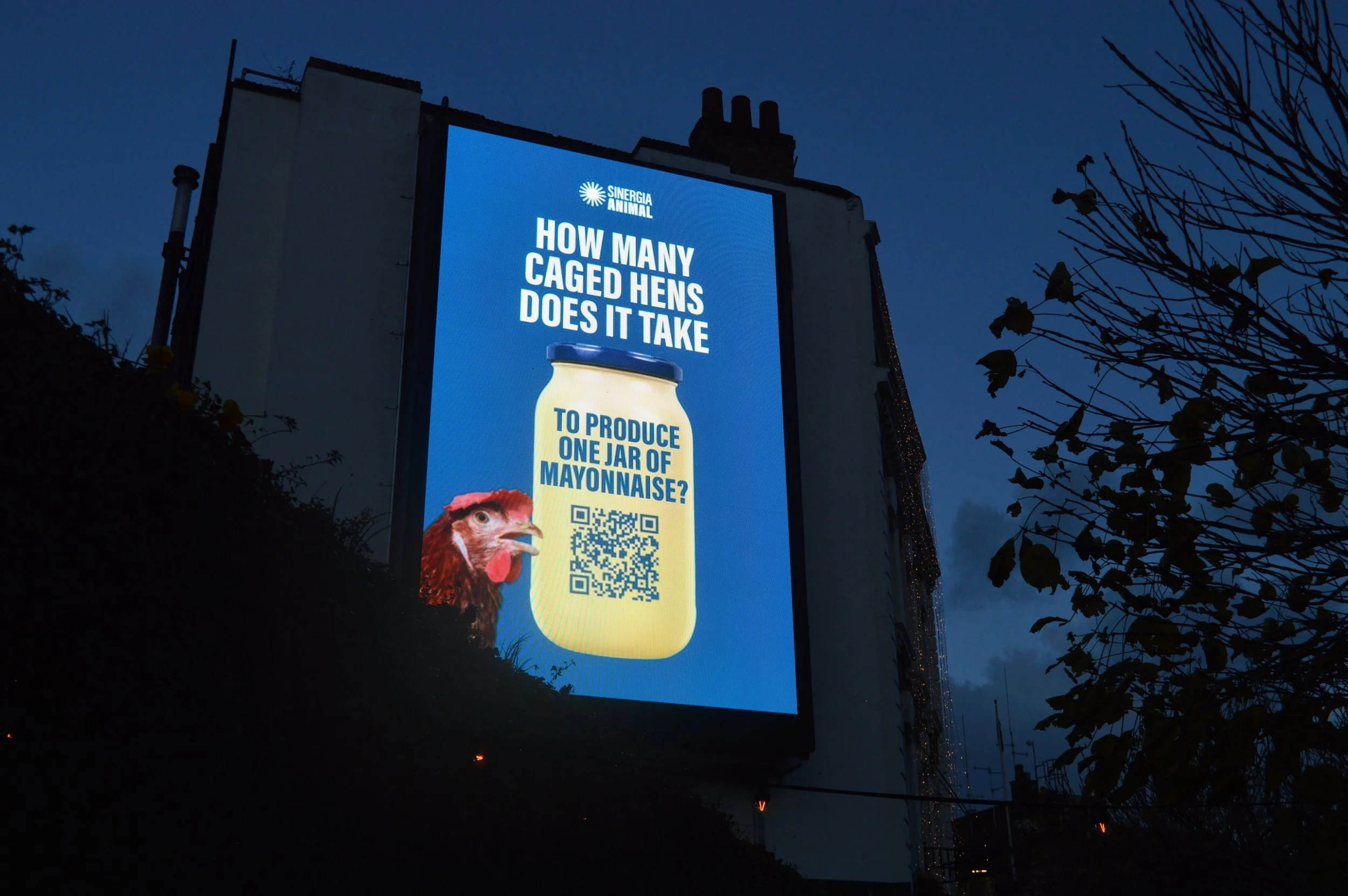
Photo credit: Jacqueline Guzman
This Thursday (19 November 2026), activists from Sinergia Animal gathered outside Unilever’s global headquarters in London with a clear message: animals and consumers in the Global South do not deserve lower standards of respect and transparency.
The mobilization follows the release of our latest undercover investigation in Malaysia, which exposes the harsh reality of industrial caged egg production. The protest challenges the inconsistency of the company (parent company of Hellmann’s, the world’s leading mayonnaise brand), which abandoned its global commitment to eliminate the use of eggs from caged hens.
A Policy of "Double Standards"
Although Unilever achieved its goal of 100% cage-free eggs in Europe and North America, its own most recent corporate reports reveal that only 27% of its eggs are cage-free in Asia and 47% in Latin America.
Last year, the company quietly scaled back its 2018 pledge to ban battery cages across its entire global supply chain. Unilever restricted its timelines to high-income markets only, leaving millions of animals and consumers in Southeast Asia and Latin America behind.
This shift in stance contrasts sharply with the brand’s own track record in the UK, where Hellmann’s mayonnaise has used 100% cage-free eggs since 2008. In Western Europe, Unilever even publicly supported the 2021 European Citizens’ Initiative to ban the use of cages in agriculture.
"Unilever recognized the cruelty of battery cages in Europe years ago, yet it continues to leave millions of animals in developing nations trapped in extreme confinement. If cage-free standards are non-negotiable for UK consumers, why are animals and consumers in Southeast Asia and Latin America subjected to a lower moral baseline?" — Jacqueline Guzmán, Global Corporate Engagement Director at Sinergia Animal
What Our Investigation Revealed in Malaysia
Every year, Unilever uses approximately 1.38 billion eggs worldwide, which equals the lives of roughly 4.9 million laying hens.
Our investigation in Malaysia closely documents the impact of battery-cage systems: overcrowded environments where each bird spends its entire life in a space usually smaller than an A4 sheet of paper, unable to even stretch its wings or perform basic natural behaviors.
Industry figures in the country reinforce the urgency for corporate action:
Malaysia produces about 17.39 billion eggs per year;
It is estimated that less than 0.3% come from cage-free systems, meaning 99.7% of hens live in confinement;
Although the documented farm was not identified as a direct supplier to Unilever, the footage portrays the standard reality of the local market when major buyers fail to demand minimum animal welfare criteria.
Change Is Already Possible, and Competitors Are Moving Forward
Transitioning to cage-free systems is not only an ethical demand, but a technically feasible reality that is expanding across Southeast Asia. Other industry giants, such as Nestlé, have maintained their global commitments and already report 81% progress worldwide, proving that progress is also possible in the Global South when corporate will exists.
Given this scenario, we are calling on Unilever to assume its responsibility as a market leader and take three urgent steps:
Restore its global commitment to source 100% cage-free eggs across all regions where it operates;
Publish a detailed action plan, with clear targets and timelines to meet this goal worldwide;
Increase transparency by disclosing country-level data on the origin of the eggs it uses.
"With their massive purchasing power and global footprint, market leaders like Unilever have the responsibility to drive sustainable food systems globally, not just where regulation or market pressure forces them to," adds Jacqueline Guzmán.