
As global egg consumption continues to rise, it is crucial that consumers worldwide are able to understand how the eggs they are buying are produced - shoppers should have the right to choose products that give higher welfare for farmed animals.

Where does our food come from, and under what conditions were the animals raised?
This question is particularly pressing in Argentina, the world leader in per capita egg consumption in 2025, on track to reach an unprecedented record of 430 eggs per person in 2026, according to poultry industry projections. Despite this elevated level of consumption, a profound information gap persists in the Argentinian market. To bridge this divide and uphold fundamental consumer rights, Sinergia Animal Argentina has developed a pioneering Egg Labeling Bill (Proyecto de Ley de Etiquetado Transparente de Huevos), formally introduced in the National Congress by National Congresswoman Gabriela Estévez.
The legislative initiative aims to incorporate mandatory, standardized production-method labeling into existing food packaging rules and establish strict truth-in-advertising standards across the country.
Uncovering the Information Gap: Findings from Sinergia Animal's Survey
While eggs are an essential daily staple in Argentine households, public understanding of domestic egg production practices has historically remained remarkably low.
To quantify this awareness deficit, Sinergia Animal Argentina conducted a national public opinion survey, revealing a striking disconnect between consumer knowledge and commercial realities:
Key Survey Finding: more than 78% of Argentinians are entirely unaware that approximately 90% of Argentina's national egg production originates from industrial cage-based battery systems.
This survey underscores how the absence of mandatory labeling leaves millions of shoppers in the dark. Without clear point-of-sale information, concerned consumers are forced to independently investigate complex supply chains or rely on unverified marketing claims. The proposed legislation solves this problem by bringing clear, reliable information directly to the packaging at the moment of purchase.
Standardizing Packaging Truth: The Four Production Categories
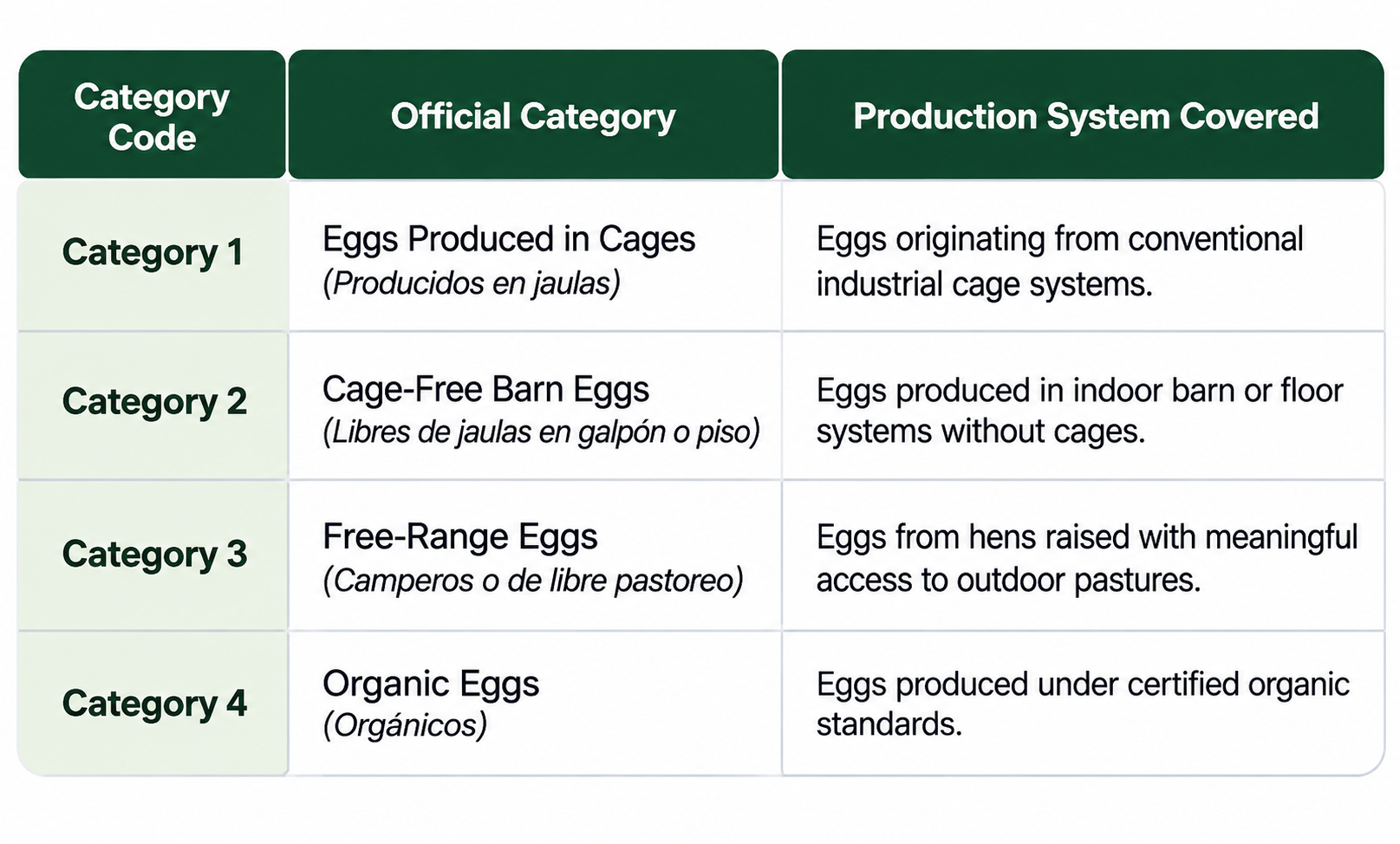
Under the proposed legislation, mandatory labeling must appear on the primary front panel of egg packaging in a format that is visible, legible, and easily understandable for consumers. The bill establishes four official categories:
Ending Misleading Advertising and Graphic Elements
A key distinction of Sinergia Animal's bill is its focus on commercial advertising and visual representation. Current retail packaging frequently depicts hens roaming outdoors on sunny pastures, even when the cartons contain eggs from cage systems.
The proposed law explicitly prohibits the use of images, expressions, or graphic elements that could lead consumers to error. Under the new rules, packaging for eggs produced in cage systems would be legally barred from displaying outdoor or pasture imagery, aligning commercial promotion with actual farming practices.
Grounding Transparency in Consumer Rights
Sinergia Animal's advocacy strategy emphasizes that access to truthful information is a fundamental civic right rather than a corporate choice.
"We are promoting this bill because we believe that access to information should not depend on the willingness of individual companies to provide it," says Romina Viscarret, Director of Sinergia Animal Argentina. "Clear and consistent rules are essential to ensure that everyone can know how the food they purchase is produced and make their own decisions. This is not about telling anyone what to buy, but about guaranteeing that they can make informed choices."

The legal framework of the bill is based on Article 42 of the Argentine National Constitution, which guarantees consumers the right to receive adequate and truthful information regarding commercial products.
National Congresswoman Gabriela Estévez, who formally presented the bill in Congress, explained its legal and constitutional foundation, "we base it on the National Constitution, on consumer rights, and on the laws that protect us."
Congresswoman Estévez noted that the initiative already enjoys support from various political groups in Congress and that work is underway to expand that cross-party coalition. Centering the proposal on consumer rights provides a unifying perspective across political lines.
Regulatory Oversight and Fair Transition Timelines
The bill is designed to be fair, achievable, and non-disruptive to the market:
Consumer-Choice Focus: The bill does not propose banning the sale of eggs from caged hens or imposing a specific production system. Its sole objective is to ensure that differences between production methods are transparent.
12-Month Adjustment Period: Producers and retailers will be granted a maximum adjustment window of twelve months from the date implementing regulations are issued to update packaging and advertising.
Enforcement: The text establishes administrative penalties for non-compliance to ensure consistent market-wide implementation.
Global Context. Argentina Joins an International Movement
Argentina's proposed Egg Labeling Bill is part of an established global legislative trend toward mandatory production-method transparency. Similar systems are already in force across major international jurisdictions such as the European Union.